
Last Updated: 8 months ago
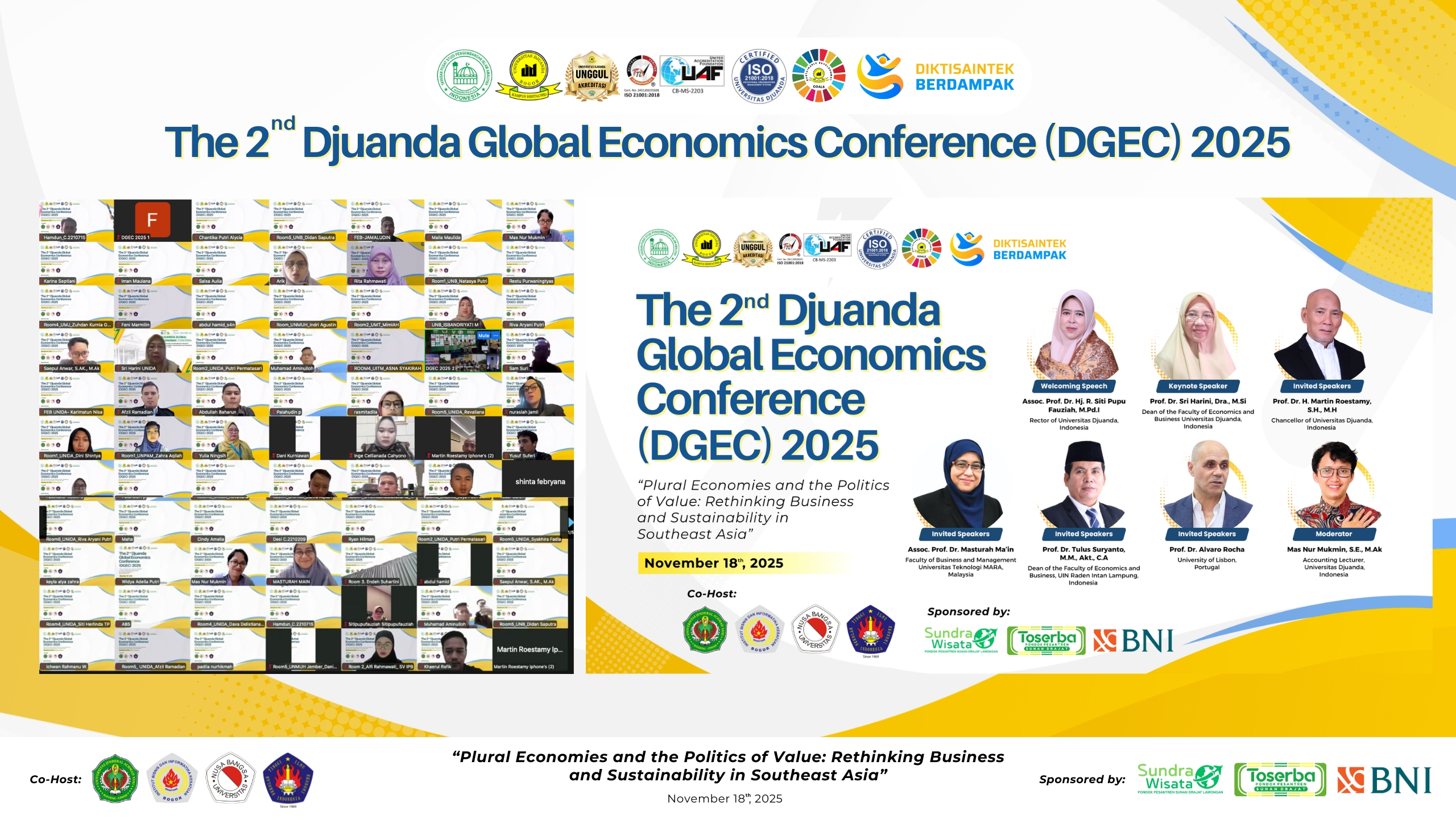
The Faculty of Economics and Business (FEB) of Djuanda University (UNIDA) is organizing the 2nd Djuanda Global Economics Conference (DGEC) 2025 on Tuesday, November 18, 2025. This international conference, which will be held online via Zoom Cloud Meetings, will be attended by hundreds of participants from various domestic and foreign universities.
With the theme “Plural Economies and the Politics of Value: Rethinking Business and Sustainability in Southeast Asia,” this year's event highlights the dynamics of plural economies, the politics of value, and sustainability challenges in the Southeast Asian region.
The event was opened by the Rector of UNIDA, Assoc. Prof. Dr. Hj. R. Siti Pupu Fauziah, M.Pd.I, who emphasized that global changes require universities to strengthen cross-border cooperation through research and academic dialogue.
“The world is facing rapid economic change, geopolitical instability, and digital disruption in various sectors. These conditions require us to develop a new framework of thinking that is more inclusive, sustainable, and equitable,” he said in his speech.
He also conveyed UNIDA's commitment to strengthening research networks and expanding the benefits of science for the global community.
The 2nd DGEC 2025 featured Keynote Speaker Prof. Dr. Sri Harini, Dra., M.Si, Dean of FEB UNIDA, as well as four international and national invited speakers, namely Prof. Dr. H. Martin Roestamy, S.H., M.H (Djuanda University), Assoc. Prof. Dr. Masturah Ma'in (MARA University of Technology, Malaysia), Prof. Dr. Tulus Suryanto, M.M., Akt., C.A (UIN Raden Intan Lampung), and Prof. Dr. Alvaro Rocha (University of Lisbon, Portugal). The event was moderated by FEB UNIDA lecturer Mas Nur Mukmin, S.E., M.Ak.
As the keynote speaker, Prof. Dr. Sri Harini, Dra., M.Si emphasized the importance of understanding economic, social, and cultural diversity in formulating sustainable development policies. She outlined four main focuses of the conference, including the importance of viewing the economy as a system embedded in institutions and the business world's response to global dynamics.
“Understanding how economic, social, and cultural values intersect in shaping business direction and sustainability is a key question that needs to be answered by academics and practitioners in the region,” he said.
During the presentation session, Prof. Dr. H. Martin Roestamy, S.H., M.H explained the financial risks, social threats, and legal protection inequalities that arise due to the proliferation of digital lending services, both legal and illegal.
In this forum, Prof. Dr. H. Martin Roestamy, S.H., M.H emphasized that the rise of online lending is not just an individual issue, but has become a potential national threat. Aggressive expansion of the industry increases the risk of rising bad debt, which could disrupt the country's financial stability.
As a recommendation, Prof. Dr. H. Martin Roestamy, S.H., M.H emphasized the urgency of strengthening regulations by the government and OJK to crack down on illegal online lending practices. He also encouraged the establishment of a mentoring and psychological rehabilitation scheme for victims of online lending terror.
Meanwhile, Assoc. Prof. Dr. Masturah Ma'in discussed the concept of plural economics as an approach that combines social, ecological, and community values. She emphasized that environmental challenges and social inequality in Southeast Asia require a more inclusive economic model with collaboration between communities.
Next, Prof. Dr. Tulus Suryanto, M.M., Akt., C.A then explained the urgency of strengthening national resilience in the digital era. He explained that digital literacy, data governance, and strengthening academic research have a vital role in maintaining the integrity of the national system.
On the same occasion, Prof. Alvaro Rocha provided his perspective on digital governance and the development of a global academic ecosystem. He emphasized the important role of integrating digital research and innovation to build an adaptive and competitive society.
The 2nd DGEC 2025 is supported by Jenderal Achmad Yani University, Kesatuan Business and Informatics Institute, Nusa Bangsa University, and Jakarta Indonesian College of Economics as co-hosts. In addition, this event is also supported by sponsorship from Bank BNI, Sundra Wisata, and Toserba PP Sunan Drajat.