Loading...
Profile

Islamic Economy

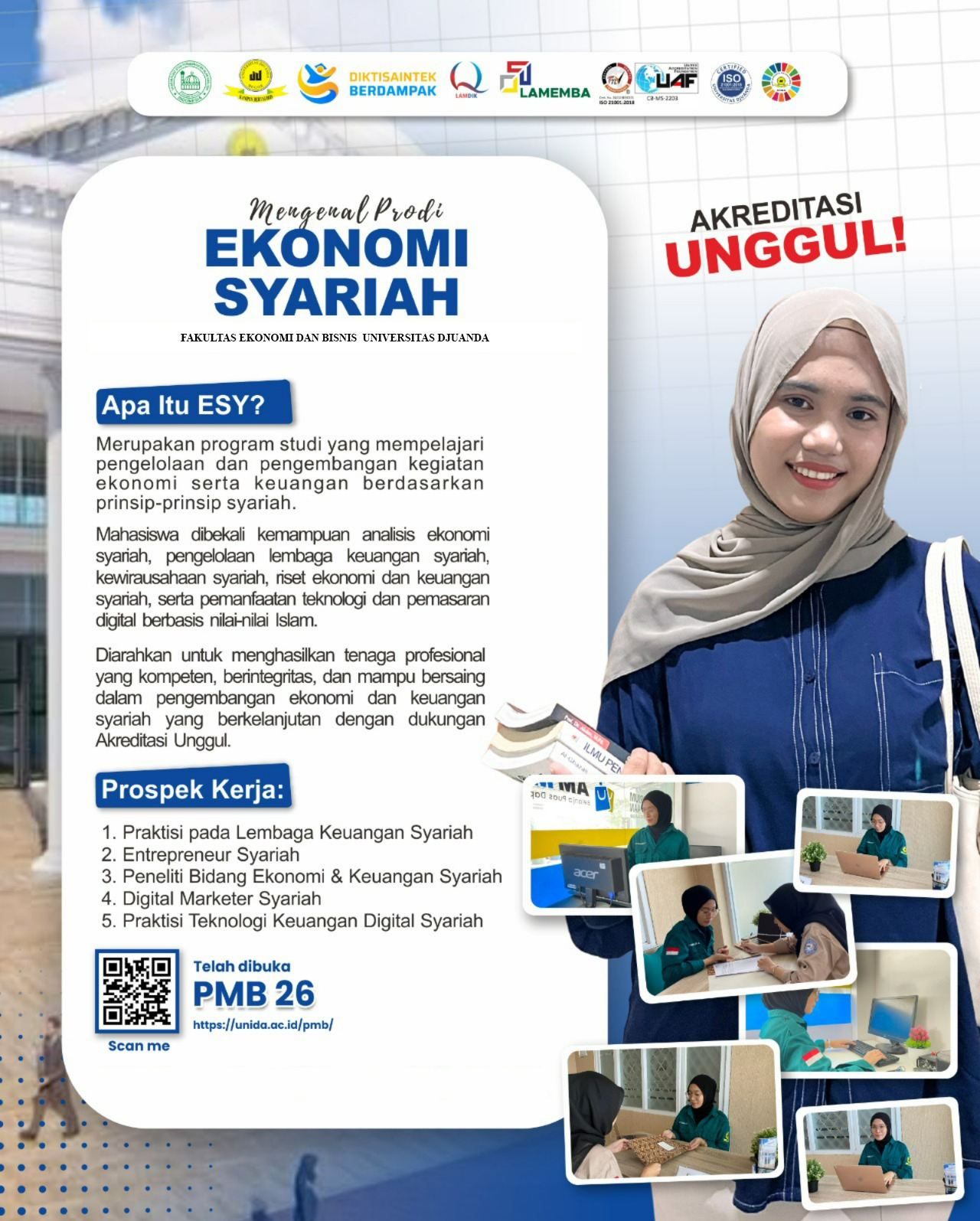
Accreditation: UNGGUL
The Islamic Economics Program is an academic program that focuses on the management and development of economic and financial activities based on Sharia principles.
Students are equipped with skills in Islamic economic analysis, management of Islamic financial institutions, Islamic entrepreneurship, Islamic economic and financial research, as well as the use of technology and digital marketing based on Islamic values.
Aimed at producing competent professionals of high integrity who are capable of competing in the field of sustainable Islamic economics and finance, supported by Excellent Accreditation.


To become a leading academic program in the field of Islamic economics, dedicated to enriching the lives of the nation through a unified vision of Tawhid and international standards

  1. Providing modern higher education within academic programs that foster and advance the field of Islamic economics.
  2. Conducting creative and innovative research within the academic program to advance the field of Islamic economics.
  3. Conducting community service within the academic program by disseminating creative and innovative research findings in the field of Islamic economics that are beneficial to the community.
  4. Implementing higher education management within academic programs in accordance with the principles of good university governance.
  5. Building a campus life rooted in monotheism within the academic program.
  1. Producing graduates who are committed to monotheism and internationally competitive in the field of Islamic economics.
  2. Developing modern, internationally recognized academic facilities within the academic programs.
  3. To produce innovative, internationally recognized research focused on advancements in Islamic economics, grounded in the development of science and technology.
  4. To engage in community service that provides practical, useful, and beneficial solutions for the community in the field of Islamic economics.
  5. Improving the quality of higher education governance that is transparent, accountable, autonomous, equitable, and participatory within academic programs grounded in monotheism.
  6. Fostering a culture of monotheism in all academic and non-academic activities for UNIDA students within their respective academic programs.
  1. The production of graduates who are competent in the field of Islamic economics and internationally competitive.
  2. The availability of modern, internationally recognized academic facilities within the program.
  3. The achievement of cutting-edge and renewable research in the field of Islamic economics, which is published, holds intellectual property rights, and is recognized.
  4. The implementation of commercialization through business development within the academic program, to support the revenue of the faculty and university and to boost the local economy.
  5. The achievement of public satisfaction with the service provided by the academic staff of the program, which is both effective and efficient.
  6. The widespread dissemination of research findings and community service outcomes by the academic staff of the program, both within the academic community and among the general public.
  7. The achievement of professionalism among faculty and staff within the academic program that exceeds national standards.
  8. The establishment of a transparent, accountable, independent, equitable, and participatory quality assurance system within the Tawhid-based study program.
  9. The development of monotheistic-minded students within a monotheistic-minded campus environment.